The price point that trains you to expect disappointment.
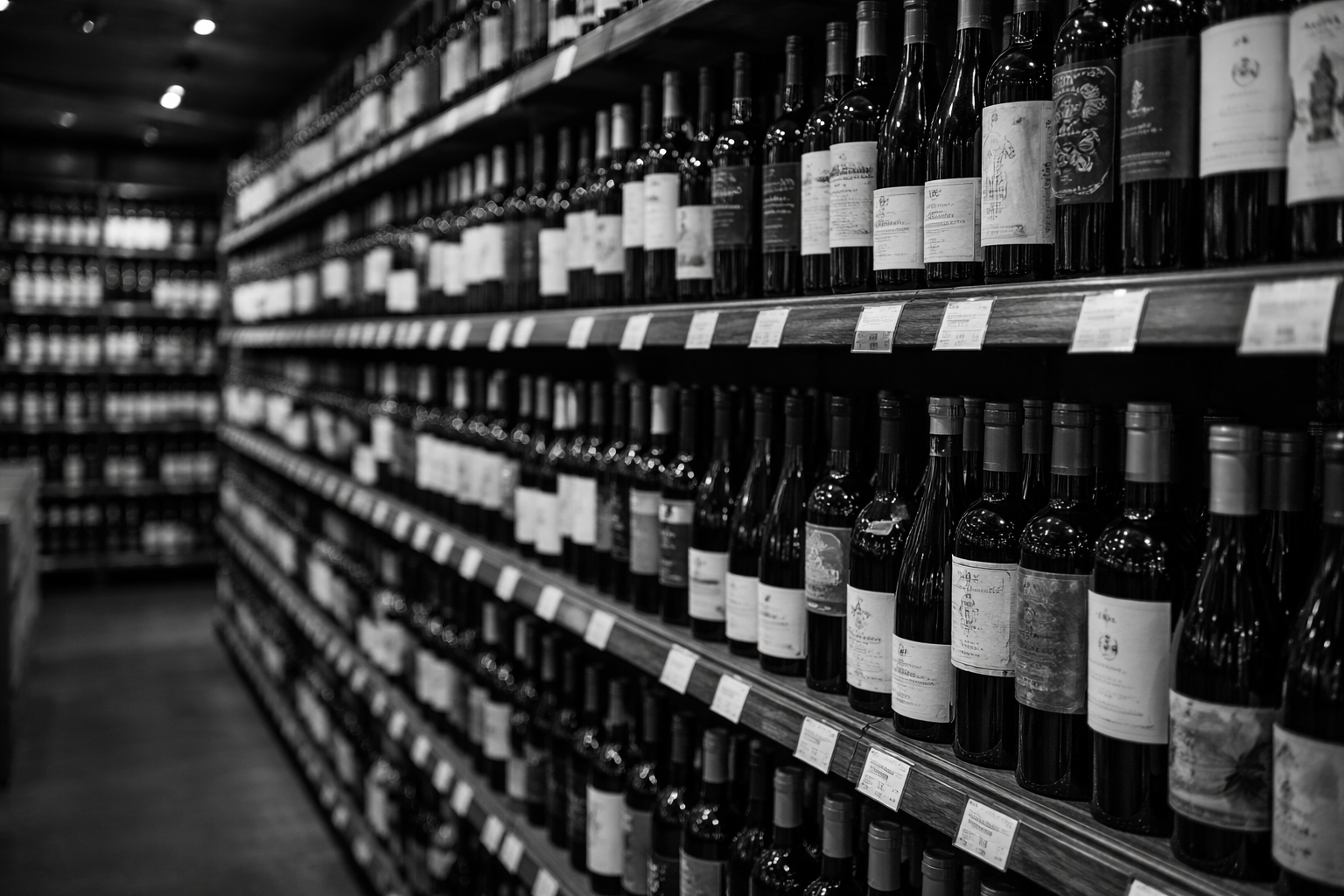
There’s a dead zone in most wine shops. You can feel it.
Walk the aisle slowly. Past the bottom shelf with labels that look like they were printed during a power outage. Past the $12 bottles promising “bold” and “rich” in fonts that shout. Then you hit it—the $16 to $20 stretch. Clean labels. Respectable regions. Nothing embarrassing. Nothing exciting.
The $18 bottle is the one you grab when you don’t want to think too hard.
It’s the “safe but not cheap” choice. The bottle you bring to dinner when you don’t know the host well enough to flex and don’t know them poorly enough to show up with beer. It signals effort. Moderation. Taste.
It also trains you to expect… fine.
Not terrible. Not transcendent. Fine.
The industry loves this price. It’s where margins start to breathe. It’s where branding does the heavy lifting. It’s where a wine can be engineered to offend no one and still feel like a step up from grocery-store chaos.
Here’s the lie: $18 feels like quality.
It feels like you’ve crossed some invisible threshold. Like you’ve graduated from “cheap wine” into “real wine.”
But price is a terrible translator of intention.
At $18, a lot of producers are playing defense. They’re smoothing out edges. Adjusting acid. Adding a little sweetness you won’t consciously register but will absolutely respond to. Oak chips instead of barrels. Packaging that whispers European restraint while the liquid inside is tuned for mass appeal.
Again—nothing illegal. Nothing sinister. Just calibrated.
You drink it and think, “Yeah, that’s good.” Then you forget it before the cork hits the trash.
That’s the training.
If your baseline becomes $18 equals decent, you stop hunting. You stop asking whether the wine is honest or just competent. You start assuming that more money equals more meaning.
Sometimes it does.
Often it doesn’t.
There are $14 bottles made by obsessive farmers who care more about their vineyards than their margins. There are $28 bottles coasting entirely on label gravity. The number is a clue at best, camouflage at worst.
The real question isn’t “Is $18 enough?”
It’s “What am I paying for?”
Farming? Small production? Real oak? Or a focus group that decided you like the word “reserve”?
Here’s the move next time you’re in that dead zone:
Don’t sort by price first.
Sort by importer or producer.
Find the small print on the back label. Who brought it into the country? Who made it? Google them if you have to. Two minutes of curiosity beats five years of drinking beige.
Or ask the person in the shop:
“What’s the most honest thing you have under $20?”
Watch their face. That question changes the energy. It forces a choice between inventory and integrity.
Some of the best bottles I’ve had in the last year cost less than a cocktail. Not because they were cheap—but because they were clear about what they were.
The $18 lie isn’t that the wine is bad.
It’s that the number is doing the thinking for you.
Confidential note: The most expensive ingredient in wine isn’t oak. It’s story.
Share:
Natural Wine: Fun, Not Holy